

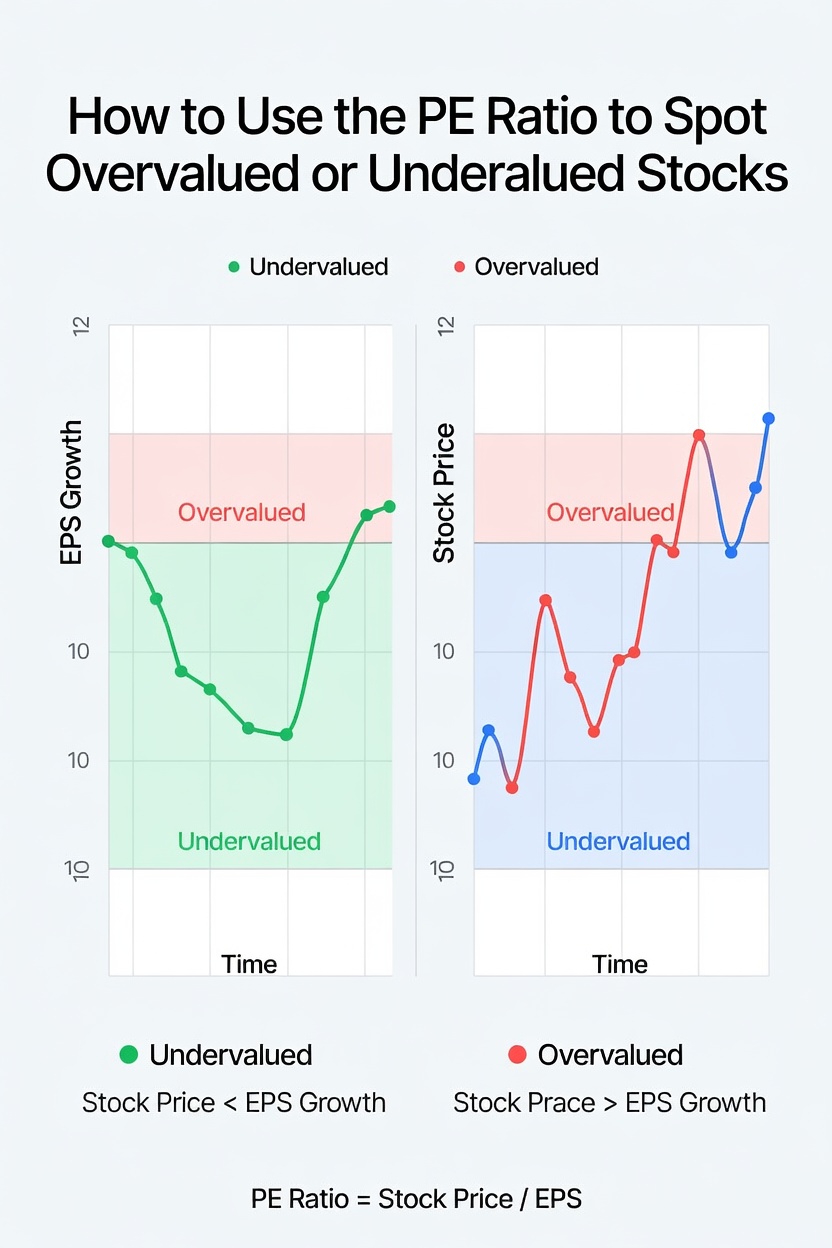
One of the most popular tools investors use to judge a stock’s valuation is the Price-to-Earnings (PE) ratio.
By looking at the historical PE ratio, you can see how the market has valued the company over time. This helps you understand whether the stock is currently trading at a premium (expensive) or a discount (cheap) compared to its past trends.
What the PE Ratio Really Tells You
The PE ratio compares the stock’s current price to its earnings per share (EPS).
- A high PE usually means the market expects strong future growth.
- A low PE often suggests the stock may be undervalued or out of favor.
However, the PE ratio has important limitations.
Important Warning: When PE Ratio Doesn’t Matter
PE ratio is not useful for companies with very low or negative earnings.
- If a company has negative earnings (it’s losing money), the PE ratio becomes meaningless or even misleading.
- In these cases, focus instead on Revenue Growth. We often like companies with negative earnings if they show steady and strong revenue growth. This suggests the company could break even and become profitable in the future.
When PE Ratio Is Most Useful
The PE ratio works best for profitable companies with stable or high earnings.
By comparing the current PE to the stock’s historical average:
- If today’s PE is near its highest levels → The stock may be overvalued (expensive).
- If today’s PE is near its lowest levels → The stock may be undervalued (cheap relative to its earnings).
Final Takeaway
Always check the PE ratio in context:
- Use it for profitable, established companies.
- For early-stage or loss-making companies, shift your focus to revenue growth and future profitability potential.
Understanding when to use (and when to ignore) the PE ratio will help you make smarter investment decisions and avoid common valuation mistakes

Comments