

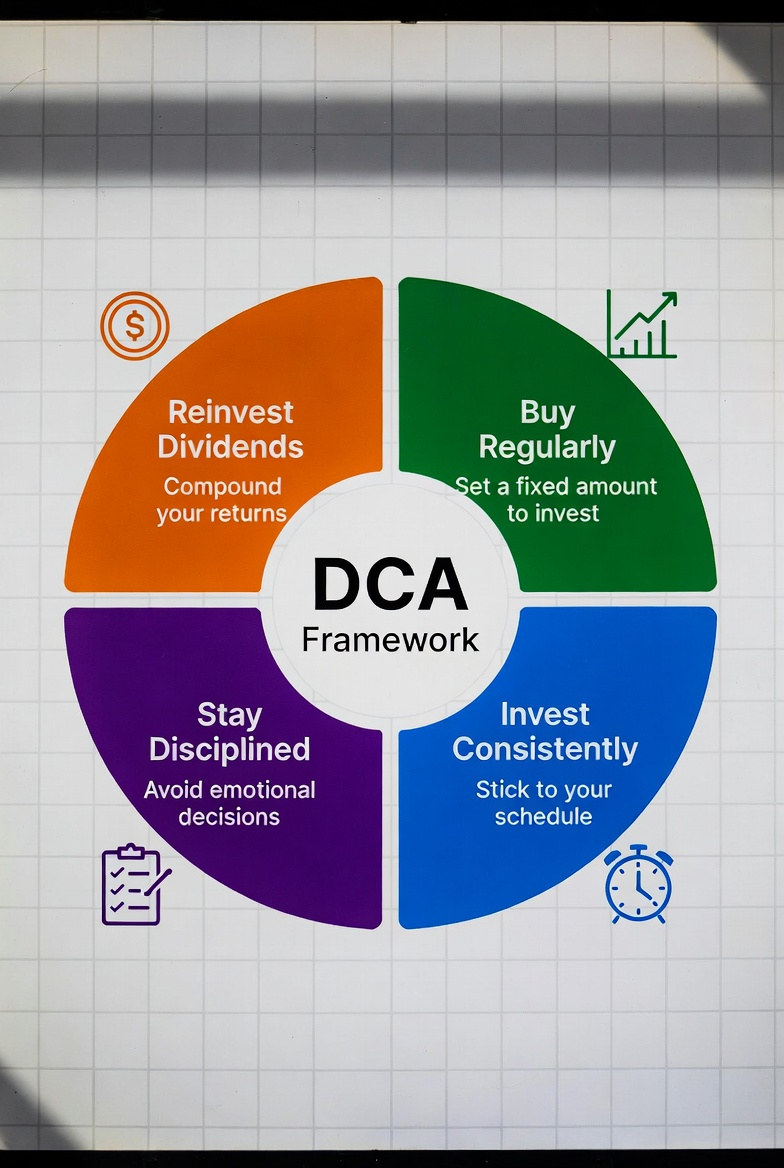
Dollar-Cost Averaging (DCA) is one of the most popular investing strategies — but many beginners use it incorrectly and end up hurting their portfolio.
The key is to treat DCA as a flexible framework, not a rigid rule. Here’s how to do it smarter and safer.
1. Don’t Buy Every Dip
A stock that rallies +100% can easily drop -50%. If you rush to buy every small 5–10% pullback, you’ll quickly run out of cash and have nothing left when a real opportunity (or deeper dip) appears.
Rule: Be selective. Not every dip is worth buying.
2. Scale With Magnitude
Different stocks require different dip sizes before you add to your position:
- Large-cap stocks (more stable): Consider adding on dips of -15% to -25%.
- Small-cap or high-volatility stocks: Wait for deeper corrections of -30% to -60%, especially if they ran up quickly.
3. Size Your Adds Wisely
DCA does not mean doubling down with the same amount.
- If a stock drops -30%, consider adding up to 50% of your original position size — not 100%.
- This keeps your risk balanced and prevents you from becoming overly exposed to one name.
4. Timeframe Matters
Always consider how fast the stock ran up:
- Look at performance over the last 3 weeks, 3 months, and 12 months.
- The faster and sharper the rally, the deeper the dip you should wait for before averaging down.
5. Is DCA Really the Best Move Right Now?
Before adding to a losing position, ask yourself:
- Is there a new buy signal with better risk-reward?
- Would I feel comfortable if the stock dropped another 20%? (If not, you may already be overexposed.)
- Would reallocating money into other stocks or sectors be a smarter move?
Sometimes the best decision is not to DCA — but to wait or diversify instead.
6. Consider Your Personal Context
Your DCA strategy should match your situation:
A. If You’re Small (Good for Earlier DCA)
- Your initial position is tiny
- Your portfolio is small compared to your net worth
- You have strong monthly savings to replenish cash quickly
→ You can start averaging in on smaller dips.
B. If You’re Big (Be More Patient)
- Your position is already large
- Your portfolio makes up a big part of your net worth
- You have limited cash flow or savings buffer
→ Be very cautious. Wait for deeper, more meaningful dips and keep plenty of dry powder.
Takeaway: DCA Is a Framework, Not a Rule
Smart DCA means adapting to:
- The stock’s volatility
- Your personal financial situation
- Your overall portfolio balance
Be patient, size your adds intelligently, and only buy dips that are truly meaningful.
The goal is to capture long-term upside while keeping enough cash to survive the deep drops that inevitably come.

Comments